Talk given at Teardown Portland 2026, July 2026.
Every device that someone can physically get their hands on is a hardware security problem, whether or not it has a radio. The question worth asking isn’t “if” someone wants to get their hands on your device for malicious purposes — it’s “who are they, and what could they do once they had it?” The first question is specific to your product; the second is answerable once you know how attackers actually approach hardware, which is what this talk works through.
Six bins, roughly by cost and invasiveness
- Research — datasheets, third-party teardowns, extracted firmware, even social engineering against support staff. The goal isn’t just “how does this work” but “where did the designers make an assumption they never actually enforced” — every attack downstream starts by invalidating one of those.
- Passive observation and logical attacks — probing exposed ports and internal signals, checking whether the debug port is locked, brute-forcing a short password, replaying a captured transaction, or just fuzzing the UART with garbage. The 2010 PlayStation 3 hack started here: watching signals to the console’s memory revealed a
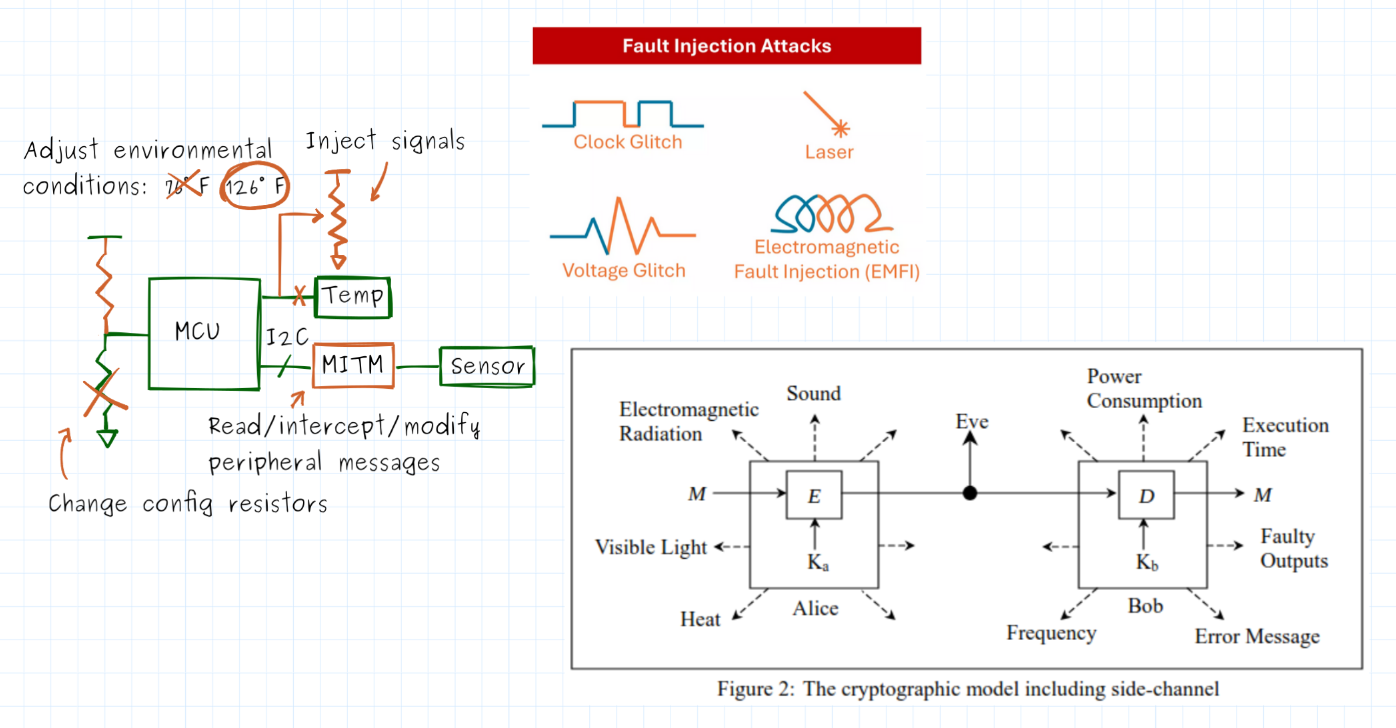
free()operation that could be glitched, resulting in a full compromise. - Physical modification — cutting a trace, swapping a strap resistor to change what hardware revision the firmware thinks it’s running on, injecting a false signal onto an analog sensor line, or pushing the device outside its rated environmental range to see what breaks.
- Side-channel attacks — extracting secrets from what a device leaks just by operating, without any modification at all. Timing is the easiest to grasp: a naive
strcmp-style password check returns faster on the first mismatched byte, which turns a billion-guess brute force into 36 guesses per digit (a real, shipped “secure” external hard drive was broken exactly this way through its error LED). Power analysis goes further — simple power analysis can read key bits directly off a single trace for algorithms like textbook RSA, and differential power analysis uses difference-of-means statistics across thousands of traces to recover an AES key one byte at a time, without ever attacking AES itself. - Fault injection — deliberately pushing a device outside its operating envelope to induce a skipped instruction, a corrupted fetch, or a flipped memory value: a crowbar glitch on the supply rail, clock double-pulsing, EM pulses, or a laser on a decapped die. This is exactly how the Xbox 360 was broken in 2011 — the second-stage bootloader’s kernel hash check was a single conditional, and glitching past that one branch let attackers load an unsigned kernel.
- IC decapping and FIB editing — for a sufficiently determined, resourced attacker, exposing the silicon opens up optical side-channels, laser fault injection, and literal circuit edits with a focused ion beam. Most devices don’t need to defend against this tier — and part of good security engineering is deciding, deliberately, that they don’t.
The takeaway
None of these attacks require a state-sponsored budget, and none of them are hypothetical — every technique in this talk has a real production device it’s been used against. The point isn’t to induce despair; it’s to work backward from “what am I actually protecting, from whom, and via which of these six avenues” and spend defensive effort accordingly. Sometimes that’s as simple as locking a debug port. Sometimes it’s a lot more.
Additional Resources
- Nothing is Safe (JawnCon 0x2) — the same attack spectrum talk, with a full recording and a live DPA/fault injection demo on a ChipWhisperer Nano
- All Your Bytes are Belong to Us — the written companion on DigiKey/Maker.io, covering the same six levels in more depth
- How Hardware Gets Hacked → — a multi-part series walking through a complete attack and defense, from start to finish