Originally published on Maker.io (DigiKey).
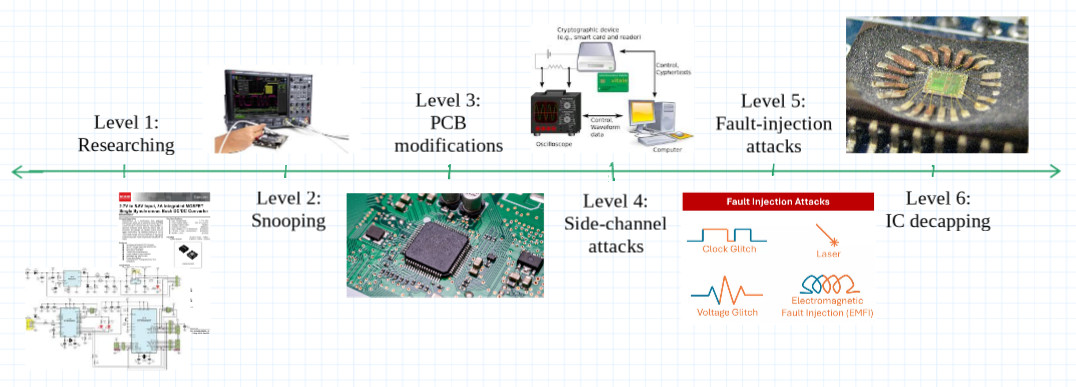
Network security gets most of the attention, but every electronic device that someone can physically touch is also susceptible to hardware attacks — including devices with no wireless radios at all. This article surveys what those attacks look like, organized into six ascending levels of cost, skill, and invasiveness.
Level 1 is reconnaissance: reading datasheets, finding reverse-engineering projects, studying the PCB. Level 2 is snooping: listening on UART, SPI, JTAG, or I2C with a logic analyzer. Level 3 is PCB modification: cutting traces, adding wires, replacing components. Level 4 is side-channel attacks: inferring secrets from timing, power consumption, or electromagnetic emissions — no physical modification required. Level 5 is fault injection: inducing computational errors through voltage glitching, EMFI, or lasers to skip instructions or corrupt memory. Level 6 is IC decapping: removing the chip’s packaging to expose the silicon die, enabling photonic side-channel analysis, optical fault injection, or direct circuit modification with a focused ion beam (FIB).
The takeaway isn’t that all devices need to defend against all six levels — it’s that the right level of protection depends on what you’re protecting and who’s likely to attack it. Countermeasures exist for every level; a device only needs to be secure enough for its actual threat model.
Additional Resources
- Nothing is Safe (JawnCon 0x2) — a talk covering the same attack spectrum with live demonstrations of DPA and fault injection
- How Hardware Gets Hacked → — a multi-part series walking through a complete attack and defense, from start to finish