Workshop given at Embedded Systems Summit 2025, October 2025.
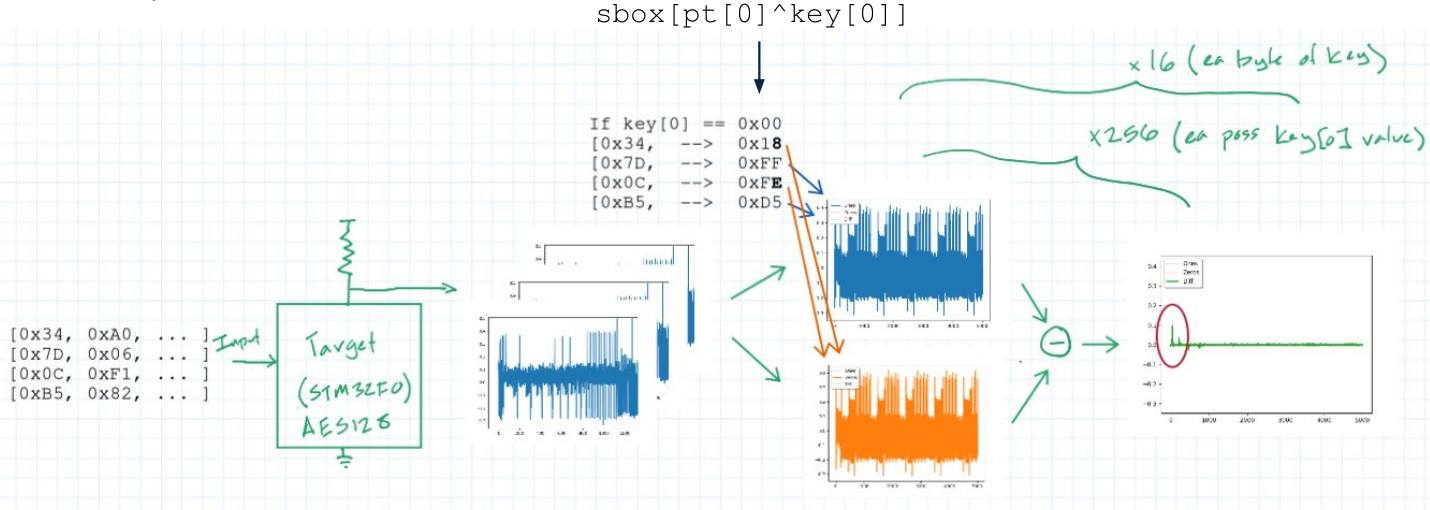
This workshop ran in three parts: situating hardware attacks within the broader attack sequence, a hands-on differential power analysis attack on AES using the ChipWhisperer Nano, and a fault injection demonstration. Attendees at the conference all got their own ChipWhisperer-Nanos, which let us work through all of the exercises live.
The hardware attack sequence
Before the hands-on material, I framed DPA and fault injection within the broader context of how hardware attacks typically unfold — from reconnaissance (datasheets, teardowns, PCB photos) through interface snooping and hardware modification, on up to side-channel analysis and fault injection. Understanding this sequence helps engineers know where to invest defensive effort. Most successful attacks don’t start with an oscilloscope; they start with a publicly available datasheet.
Differential power analysis on AES
The main event was a DPA attack on a target microcontroller running AES. The ChipWhisperer Nano captures power traces while the target encrypts known plaintexts. The attack exploits the Hamming weight model: the power consumed during an operation correlates with the number of set bits in the intermediate result. By grouping traces according to a predicted bit of the S-box output for each key byte guess, averaging, and subtracting, a peak appears at the computation moment when the key guess is correct — and washes out for wrong guesses. We worked through this in Jupyter notebooks, building up from plotting individual traces to running the full attack.
Fault injection
For the final section, I demonstrated a voltage glitching attack to bypass a password check. A brief drop on the supply rail, timed precisely to the branch instruction enforcing the comparison, causes the device to skip it and grant access without knowing the password. The ChipWhisperer Nano provides hardware trigger support for nanosecond-level precision. It’s a viscerally convincing demonstration of why “lock your debug port” is only the beginning.
The takeaway
These attacks are real and accessible. A ChipWhisperer-Nano costs around $50. The defense isn’t helplessness — it’s intentionality. Constant-time comparisons, locked debug ports, secure boot, and randomized execution delays are all within reach. The key is treating security as a design criterion from the start, not a retrofit.
Additional Resources
- Introduction to Hardware (In)Security with the ChipWhisperer-Nano (EOC 2026) — the same workshop with a full recording and exercise files
- Breaking AES with an Oscilloscope — a deeper written treatment of the DPA technique with more detail on the math and countermeasures