Originally published on Maker.io (DigiKey).
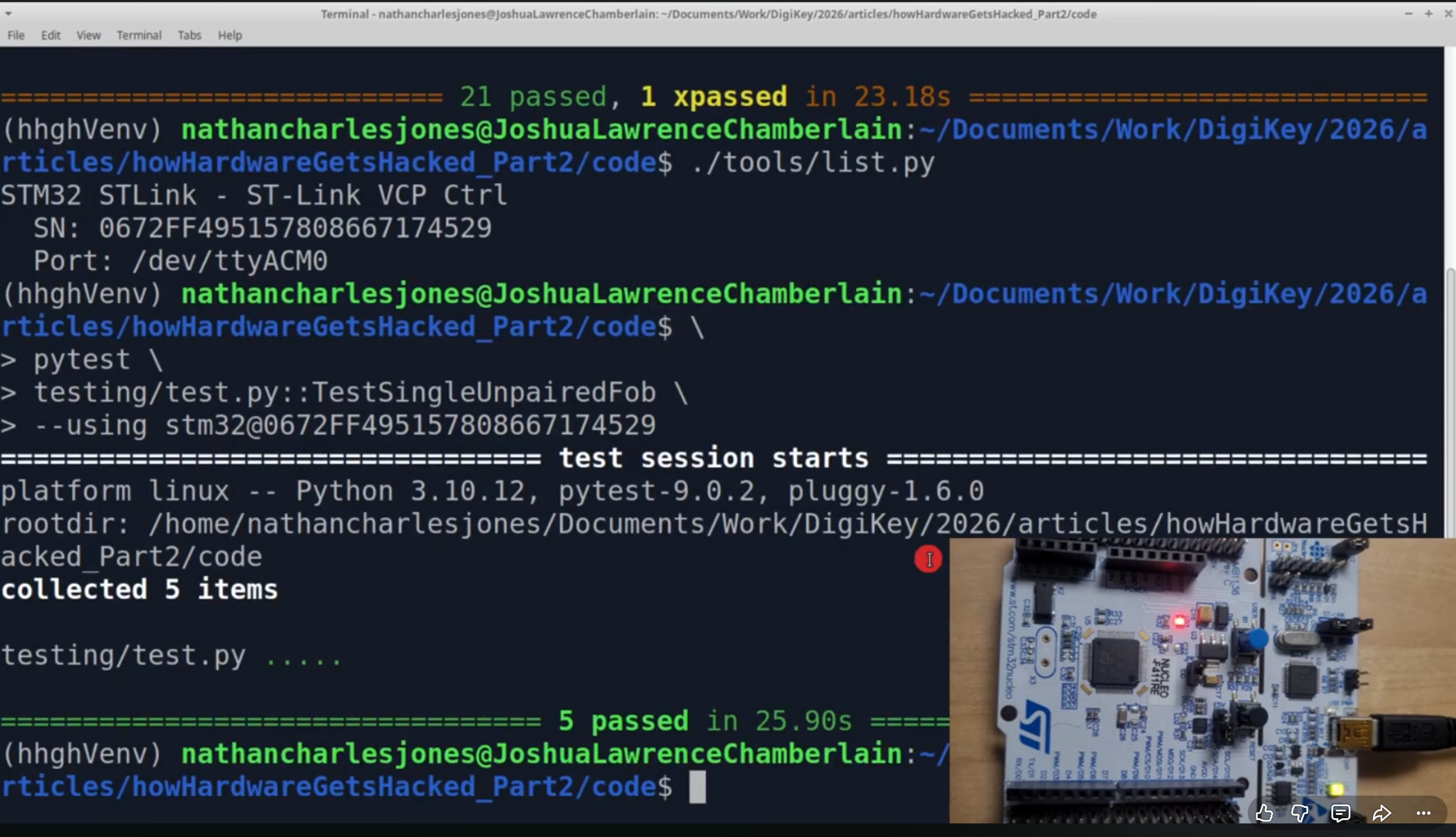
The 2023 MITRE eCTF required specific hardware and MITRE’s own bootloader. Part 2 re-builds the same car-and-key-fob project in a form you can run on your own development boards, structured as four progressive builds: a pure host simulation (no hardware required), the simulation extended with interactive test commands, a build targeting real STM32 and TM4C hardware, and a build with an automated test suite for black-box testing.
The more security-relevant half of the article examines the secret-generation pipeline. Two generation steps occur: a global step before any device is built (the right place for system-wide AES keys) and a per-device step when each car or fob is compiled, producing secrets.h and car_secrets.json. Competition rules give attackers full access to source code and build scripts but not to build artifacts — they can read car_gen_secret.py but not the secrets it generates. Whether they can infer the contents of secrets.h from the visible script alone is a question worth asking before the attack phase begins.