Originally published on Maker.io (DigiKey).
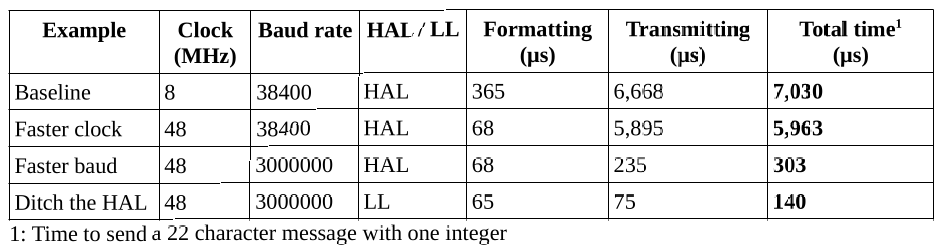
Printf’s speed problem is mostly a UART problem: at 38400 baud, transmitting even a short message takes milliseconds, which is long enough to disrupt timing-sensitive code or make printf too expensive to call often. Three changes address most of it without touching application code: run the processor at its full rated clock (8 → 48 MHz), raise the UART baud rate to the practical maximum (38400 → 3 Mbaud), and replace the STM32 HAL with the leaner LL driver for the UART peripheral. Together these take a 7,030 µs baseline to 140 µs — a 50× improvement.
The article also covers non-hardware approaches for cases where you want to call printf less even when it’s fast: batching messages, simplifying format strings, shortening message text, and running your application in a host simulator where UART timing is irrelevant.